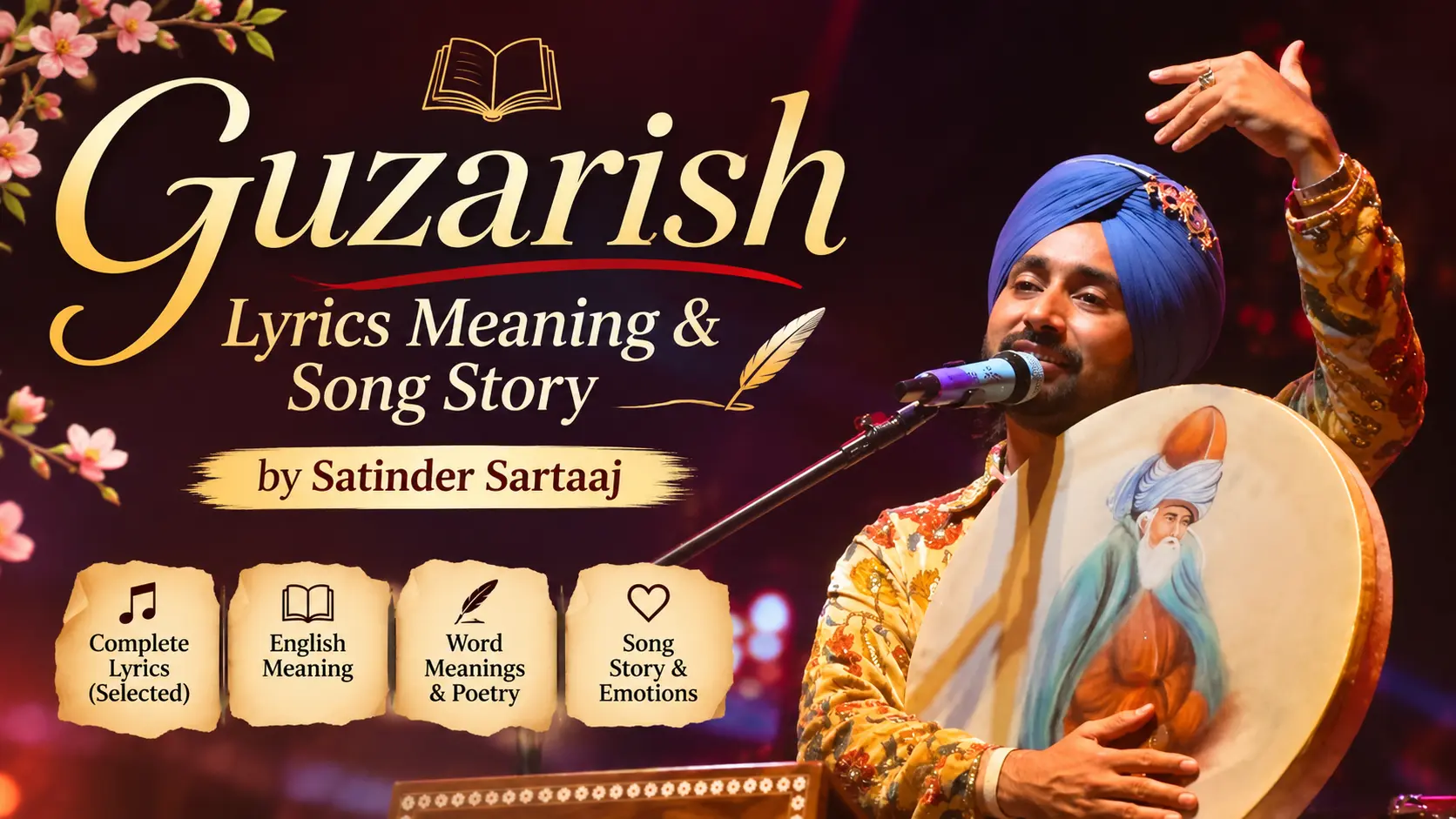
Guzarish lyrics by Satinder Sartaaj use romantic poetry to describe attraction, beauty, glances, and the excitement of being drawn toward someone.
The song is officially presented as a Punjabi song, but its writing uses many Urdu and Persian-influenced poetic words. That is why some lines can sound difficult even when the basic feeling is simple.
At its heart, Guzarish is about a lover who is fascinated by someone’s presence and wants those feelings to be noticed.
Guzarish Song Details
| Detail | Information |
|---|---|
| Song | Guzarish |
| Singer | Satinder Sartaaj |
| Written by | Satinder Sartaaj |
| Composed by | Satinder Sartaaj |
| Music Director | Satinder Sartaaj |
| Label | T-Series |
| Released | September 17, 2026 |
| Language | Punjabi |
T-Series lists Satinder Sartaaj as the music director, while contemporary coverage identifies him as the writer, composer, and singer. The official T-Series release describes Guzarish as a Punjabi song.
Guzarish Lyrics and Meaning
The easiest way to understand Guzarish is to look at the small poetic images Sartaaj keeps returning to.
The opening already sets the mood with “dil-kashi ka khwaab”, an image of beauty and attraction. The woman is not introduced through a normal description. Instead, the singer surrounds her with fragrance, light and beauty.
Then comes:
“rooh ko nazron se roshan kar diya”
The idea is that her gaze has lit up his soul.
That is not meant literally. Her eyes have such a strong emotional effect on him that he describes the feeling as light entering the soul.
The eyes matter throughout the song. They are not simply a physical feature. They become a way of communicating attraction.
“Chitthiyaan mili hain mahtaab se”
One of the most unusual images in the song is “chitthiyaan mili hain mahtaab se.”
Chitthiyaan means letters, while mahtaab is a poetic word for the moon.
The singer obviously is not receiving actual letters from the moon. He is using the moon as part of a romantic fantasy. It makes the feeling seem distant, beautiful and almost magical, as though the night itself is carrying a message.
That is the difference between translating a lyric and understanding it.
“Guzaarishon pe gaur kijiye”
This is the line that gives the song its title.
Guzarish means a request, appeal, or heartfelt plea. Gaur kijiye means to pay attention or give something consideration.
So the simple meaning is:
Please pay attention to my requests.
But the line has a softer feeling in the song. The speaker is not demanding anything. He is asking the beloved to notice what he is trying to communicate.
The repeated phrase gives the song its flirtatious quality.
“Nasha akhiyon mein”
Later, the singer compares the effect of the beloved’s eyes with wine.
The idea is that her eyes are more intoxicating than alcohol. He is not describing literal intoxication. He is trying to explain how strongly her gaze affects him.
This also connects with the earlier description of her eyes lighting up his soul. The song keeps returning to the same idea from different angles: her gaze has power over him.
From Beauty to the Language of Love
The song becomes more interesting when it moves from describing beauty to describing communication.
Sartaaj sings about “ishaaron ka muhaavra”, the idea of a language made from gestures.
That phrase changes the direction of the song.
Until this point, the singer has mostly been describing what he sees and feels. Now he suggests that two people can understand each other without saying everything aloud.
A glance can carry meaning. A small gesture can reveal attraction. Sometimes the person you like does not need to say anything for you to understand what is happening.
The following reference to “nigaahon”, or glances, reinforces this idea.
So the song gradually moves from physical admiration toward emotional connection.
Why the Moon, Roses and Spring Keep Appearing
The song uses a familiar vocabulary of romantic poetry: moon, roses, spring, fragrance and youthful beauty.
These images work together.
The moon gives the song its dreamy side. Roses suggest beauty and romance. Spring suggests freshness and the beginning of something new.
Sartaaj is not trying to tell us that these things are literally happening around the couple. He is building an emotional atmosphere.
That is why the song feels more like a romantic poem than a straightforward story.
Important Words in Guzarish
Some of the vocabulary may be unfamiliar if you mainly listen to everyday Punjabi.
Shabaab
Shabaab refers to youth or youthful beauty. In Guzarish, it belongs to the song’s larger description of attraction.
Shokhiyaan
Shokhiyaan refers to playful, teasing or lively charm. It gives the romance a lighter and more flirtatious quality.
Suroor
Suroor describes pleasure, delight, or a pleasant feeling of emotional intoxication. It fits naturally with the song’s repeated imagery of attraction and intoxication.
Ulfat
Ulfat means love, affection, or deep attachment. It is a more literary word than simply saying “love,” which suits the poetic language of the song.
Jazbaat
Jazbaat means emotions or feelings.
By the later part of the song, this word makes the emotional side of the poetry more direct.
Waakfiyatein
Waakfiyatein refers to familiarity, acquaintance, or becoming familiar with someone or something.
The word belongs to the song’s more literary vocabulary and fits its overall Urdu-influenced poetic style.
What Does the Punjab Reference Mean?
The singer says:
“woh aaye hain Punjab se”
The line gives the romantic picture a specific place.
Most of the song exists in a dreamy world of moonlight, flowers and glances. Suddenly, Punjab gives that imagined woman a clearer identity and setting.
But there is not enough information in the lyrics to build a detailed story around the line.
We should not assume that it refers to a particular real person, journey, or event. The safe reading is simply that the Punjab reference adds cultural and geographical colour to the romantic description.
Guzarish Song Story
There is no complicated plot to decode here.
The song starts with admiration. The speaker becomes fascinated by the woman’s beauty and presence. Her eyes become especially important, and the lyrics then move toward gestures, glances and feelings that do not need to be spoken directly.
By the later verses, the language becomes more openly connected with love and emotion.
So the song’s story is really the development of attraction into emotional connection.
It is less about something happening between two characters and more about what is happening inside the speaker.
Literal Meaning vs Poetic Meaning
This is especially important when looking for the Guzarish lyrics meaning in English.
Take the moon image. A literal translation tells you that the singer received letters from the moon. That gives you the words, but not the feeling.
The same happens with the comparison between eyes and wine. The singer is not saying that the woman’s eyes contain something physically intoxicating. He is describing the effect her gaze has on him.
The poetry works through exaggeration and imagery.
That is why Guzarish makes more sense when you ask not only “What does this line say?”, but also “Why did the singer describe the feeling this way?”
A Few Words Worth Knowing
If you want to understand the song without constantly checking a translation, these are the most useful words to remember:
Mahtaab = moon
Shabaab = youthful beauty or youth
Shokhiyaan = playful charm
Suroor = pleasure or emotional intoxication
Ulfat = love or affection
Jazbaat = emotions
Waakfiyatein = familiarity or acquaintance
The pronunciation of the more difficult words can vary slightly with singing style and accent. The most useful ones to recognise in the song are mahtaab, muhaavra, and waakfiyatein.
What Is Confirmed and What Is Interpretation?
The lyrics clearly establish the romantic mood, the importance of beauty and eyes, the references to the moon, roses and spring, the Punjab reference, and the repeated request to pay attention.
The deeper symbolism is interpretation.
For example, calling the moon a romantic messenger is a useful way to understand the image of receiving letters from it. But the lyrics themselves do not prove that this was the artist’s exact intended symbolism.
Watch the Official Guzarish Video
The official music video for Guzarish was released by T-Series on September 17, 2026.
Related Punjabi Song Guides
If you want to explore more Punjabi songs through their meaning and cultural context, see:
Mehndi Lyrics Meaning & Song Story, Safal Sidhu & Sudesh Kumari
Kawan Di Daar Lyrics, Meaning & English Translation – A Kay
Fine Shyt Lyrics — Guru Randhawa | English Meaning & Slang Explained
Frequently Asked Questions
What is Guzarish by Satinder Sartaaj about?
Guzarish is a romantic song about attraction, admiration, glances, gestures and the emotional effect of being drawn toward someone.
What does “Guzaarishon pe gaur kijiye” mean?
It means “Please pay attention to my requests.” In the song, it works as a gentle romantic appeal.
Who wrote and composed Guzarish?
Satinder Sartaaj wrote and composed Guzarish, and he also sings the song. T-Series lists him as the music director as well.
Is Guzarish Punjabi or Urdu?
Guzarish is officially presented as a Punjabi song, but its lyrics contain many Urdu and Persian-influenced poetic words and expressions. That combination is a major part of its literary style.